
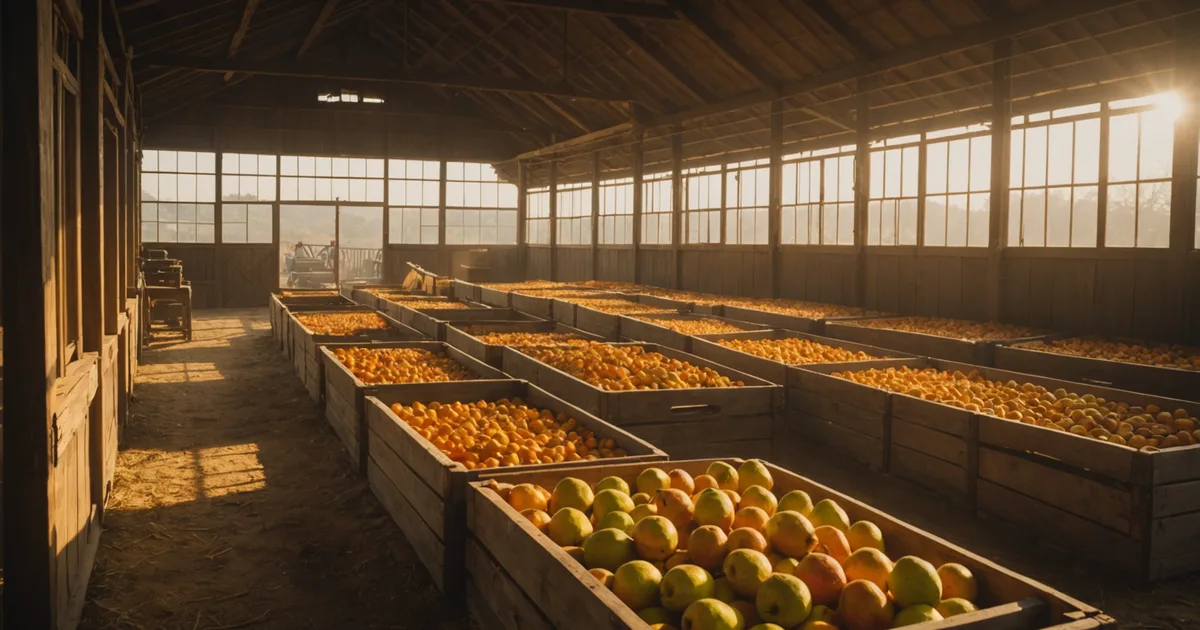
A 200-tonne apple grower in North Gyeonggi losing 18 percent between harvest and regional distribution ends up with 36 fewer saleable tonnes each season. The inputs for those 36 tonnes are already paid for, as is the harvest labor. The loss therefore comes straight out of margin rather than revenue. For many mid-scale growers, this is not an unusual season. It is the normal baseline.
This article examines growers producing 50 to 500 tonnes per season. In Korea's produce chain, that range is difficult: spoilage is financially significant, yet full cold-chain infrastructure used by major cooperatives and export operations is usually not justified. These figures are a way to frame decisions, not an exact forecast. Loss rates differ with crop, season, handling, and distribution channel.
Where Loss Occurs in Practice
Post-harvest loss does not occur at one isolated moment. It builds across several points, with each adding part of the total.
The first exposure occurs between harvest and cooling. Produce picked under summer field conditions respires quickly at ambient temperature. For stone fruit such as peaches and nectarines, respiration at 28 degrees Celsius is roughly twice the rate at 18 degrees. When transport logistics or a processing queue delays cooling by two to four hours, the packing house receives produce with a lower quality baseline.
The next exposure is during transit. Produce carried in an ambient-temperature vehicle from farm to packing house accumulates heat stress, shortening the shelf life that remains afterward. Intake may not reveal the damage: the produce can look and grade acceptably while its biological clock has already advanced.
A third point is packing-house sorting and staging. High-throughput lines move batches rapidly, but slower operations or large arrivals can leave crates in ambient staging for hours while the line catches up. Every hour in warm staging accelerates ripening.
The fourth point is rejection at the dock. Produce that clears the packing house's internal grade can still fail retailer inspection on delivery. By then, the grower has paid for harvest, transport, packing, and outbound logistics, while a rejected load returns nothing. For major Korean retail buyers, delivery appearance standards can be much stricter than packing-house standards. Experienced growers learn to price in that gap, while newer operations often encounter it too late.
How Lost Volume Hits Margin
Post-harvest loss affects margin nonlinearly. Losing 15 percent of volume does not mean losing 15 percent of margin. The margin share lost is larger because production costs for that discarded volume have already been incurred.
Take a grower producing 200 tonnes of commercial-grade peaches with a 22 percent net margin on sold volume. If spoilage and dock rejection remove 15 percent before sale, the profit loss is not merely 15 percent. The grower loses the margin on 30 tonnes while having paid their production and handling costs. Depending on fixed and variable cost shares, actual net margin may fall by 30 to 50 percent.
Grade downgrading adds another layer. Produce that remains saleable but has visual decline, surface marks, or ripeness-related softness can move from Grade A pricing to Grade B or processing-grade pricing. A grower delivering 170 tonnes after losing 30 to spoilage, with 30 percent of those 170 tonnes sold at Grade B pricing, faces a revenue shortfall that exceeds the volume-loss calculation alone.
In Korean wholesale markets, Grade B prices for stone and pome fruit are commonly 20 to 45 percent below Grade A for the same variety and pack. Applied to a meaningful share of seasonal volume, that difference is substantial.
The Coverage Shortfall
Agricultural insurance in Korea and much of Asia generally covers specified field risks such as hail, frost, flooding, drought, and pest events. Once produce leaves the field, the issue is usually classified as operations or logistics. Standard crop insurance generally does not cover spoilage caused by temperature-control failures, handling damage, or biological deterioration in transit.
Mid-scale growers therefore carry the operational risk of post-harvest loss without a financial backstop. Large operations manage it through cold-chain investment, lowering loss rates rather than insuring against them. Small growers with low absolute volumes can absorb the loss as a manageable cost. Mid-scale growers occupy neither position: the loss is too large to dismiss, but full cold chain is too costly to justify.
Some regional agricultural cooperatives provide pooled, insurance-like schemes covering part of dock rejections. Terms differ considerably, and most schemes require documented handling standards that many members do not formally record.
Calculating Preservation Step ROI
A preservation treatment's payback rests on three inputs: the current combined spoilage and rejection rate, the crop's wholesale price, and treatment cost per kilogram.
Consider a grower producing 200 tonnes per season with a combined spoilage and dock rejection rate of 14 percent. If preservation lowers that rate to 8 percent, 12 saleable tonnes are recovered. At 1,600 KRW per kilogram wholesale, that equals approximately 19.2 million KRW in gross seasonal revenue. Applying treatment across 200 tonnes at 55 KRW per kilogram costs 11 million KRW annually, producing an approximate net improvement of 8.2 million KRW per season.
This framework shifts in three important ways when its inputs change.
First, the opportunity grows with the starting loss rate. A grower losing 25 percent to spoilage and rejection can recover more from the same percentage-point improvement than one losing 10 percent. ROI is most favorable where losses are high and no coating has yet been used.
Second, value per kilogram matters. Stone fruit at 2,000 KRW per kilogram returns more for each kilogram recovered than processing-grade vegetables at 400 KRW. Treatment cost per kilogram is similar across crops, so the ratio improves as crop value rises.
Third, application strategy matters. Treating every crate, regardless of freshness, means paying for crates that may not require protection. Selective treatment aimed at crates with the highest predicted spoilage risk lowers total treatment cost and improves net ROI.
Lessons From Pilot Operations
In our first commercial season with Korean packing facilities, the greatest absolute financial recovery from combining coating with AI routing appeared in mid-scale operations with baseline dock rejection above 10 percent and no established post-harvest treatment. These facilities were also hearing informal reports from regional buyers about more frequent rejections, yet lacked structured data showing where along the chain the problem began.
Coating plus routing consistently performed better than either measure by itself. Coating lengthened shelf life for treated crates, while routing focused coating on crates with the highest predicted biological risk. That improved cost efficiency over uniform application. For a grower charged per kilogram treated, the distinction between uniform and selective coverage is material.
Boundaries of This Analysis
This financial framework covers post-harvest loss caused by biological deterioration during handling and transit. It does not cover post-harvest revenue issues that begin elsewhere.
When the main challenge is wholesale price volatility rather than spoilage, preservation can improve quality and yield but cannot fix the price. When dock rejections result from changed retailer grading standards rather than genuine quality decline, a different response is needed. When peak harvest oversupply is the core issue, longer shelf life may move spoilage later without correcting the mismatch between volume and demand.
Growers should test this framework against their own rejection records before deciding. If rejection stays below 8 percent and price is the main constraint, the ROI case may be marginal. If rejection exceeds 12 percent and records link it to handling-related quality deterioration, the figures usually support adding preservation.
For growers handling 50 to 500 tonnes per season, post-harvest loss is a material financial problem, insurance coverage has a genuine gap, and preservation can present a genuine ROI case. That combination is the reason we built this system.
See Ecogear on your packing line
Sample kits ship within 14 days of approval. No commercial commitment required.
Request a Sample Kit