
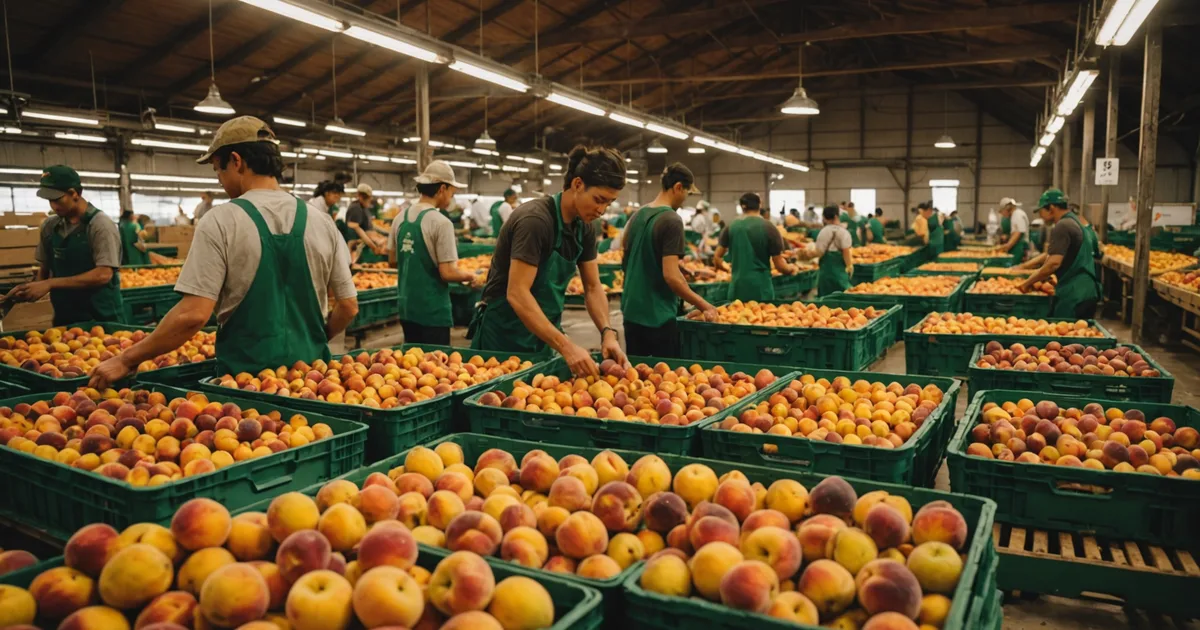
On a peach shift, even an experienced grader can visually assess only about 8 to 12 crates per hour closely enough to identify bruising, skin defects, and obvious over-ripeness. When 40 crates an hour leave the line, inspection becomes sampling rather than a full check. This is not a judgment on grader skill. It reflects the physical limits of high-volume produce handling, so some at-risk batches will pass without complete scrutiny.
The Costliest Sorting Error
The error that creates the greatest downstream trouble is often not found at the packing house. It is found at the retailer's distribution center.
A packing-house rejection consumes labor and time. The batch is isolated, the grader's call is recorded, and the lot is sent to a secondary market or discarded. The cost is high but stays inside the facility. A DC rejection comes after the produce has spent four to eight hours in refrigerated transport, adding those losses to freight, dispute administration, and possible deductions from the buyer's account.
False positives in visual grading, meaning batches released when they should have been held, generally cost more than false negatives. Under pressure on a busy shift, graders have a rational reason to pass borderline batches: holding one immediately slows the line, while a shipment rejection may not appear until days later. Data does not remove that incentive. It gives the grader stronger information when the call must be made.
How Batch Information Alters Sorting
A data-based sorting process does not remove the grader. It gives that person more information before visual inspection starts.
In Ecogear's routing system, every batch reaching the sorting line carries a freshness score drawn from intake readings for Brix, firmness, and color index. Before opening a crate, the grader can see whether the score is high, suggesting good condition, or low, signaling that the visual findings deserve closer attention.
In practical terms, attention goes first to batches where it is most likely to matter. During a shift handling 200 crates, if the routing model marks 35 as below the freshness threshold, those 35 receive the closest human review. The remaining 165 can proceed at the usual inspection pace, without requiring a separate slow-down decision for every crate.
The aim is not to substitute for human judgment. It is to place that judgment where the likelihood of a real issue is greatest. The grader's eyes still make the final call, while the model performs the initial triage.
The Seasonal Feedback Loop
The lasting benefit of data-based sorting appears not in the first season, but in the feedback loop accumulated over multiple seasons.
Each batch record stores intake freshness scores, treatment choices, and treatment timing. When a packing house also logs post-packing results, including retailer complaints or DC rejections, those outcomes can be linked to the intake scores for the same batch.
After one season of matching records, the model has cases against which its accuracy can be checked. If it over-flagged batches with high urgency scores that performed acceptably at the DC, the scoring weight for the sensor-reading combination behind the false alarm can be reduced. If it under-flagged batches that cleared the threshold but led to retailer complaints, those cases help tighten detection for similar incoming conditions.
Early on, this feedback process is more manual than it becomes later. During our pilot season, we matched DC rejection records with intake batch records by hand in end-of-season reviews at each facility. The clearest recurring pattern was that the model under-flagged certain peach varieties that develop skin flush slightly before their Brix readings reflect actual internal ripeness. Graders at two facilities independently identified those varieties as needing more attention than the Brix reading alone indicated. Both outcome records and grader observations were added to the 2025-2026 stone-fruit model version.
Changes for the Sorting Crew
When we first present batch data, line supervisors most often ask some version of: "Are you going to tell my team they are doing it wrong?"
No. The data shows where incoming risk is concentrated. The sorting team decides how to respond, with context the model lacks. A grader who has sorted peaches for ten years has calibration a Brix sensor cannot reproduce, including nuances of skin texture, stem condition, and variety-specific bruise patterns.
The practical change is in how borderline batches are discussed. Without data, a hold decision rests on a supervisor's call or a grader's visual assessment, making it hard to document or defend to a buyer. With data, the discussion includes an intake score: "This batch came in at a freshness index of 62, and our DC rejection history shows a strong correlation with batches under 65 for this variety." That is more defensible than saying the peaches looked soft that morning. The number supports the grader's call rather than overruling it, while creating an audit trail.
Where Data Falls Short
Data-based sorting strengthens the decision made at the sorting stage. It cannot guarantee what happens downstream.
The model depends on the information collected at intake. If no readings exist because the handheld Brix meter was not used that morning, or because the line sensor was out of calibration, the resulting score has low confidence and limited practical value. The system depends on disciplined data collection, which is an operating habit rather than a technical feature.
The model also cannot see what happens after a batch leaves the line. A batch with a strong intake score and the correct coating treatment can still reach a DC in poor condition if it spends six hours on a badly cooled loading dock during a summer afternoon. Handling after packing, transport conditions, and DC receiving procedures are separate variables that require separate remedies.
We make this point because post-harvest data systems are sometimes presented as though data can make the entire chain predictable. It cannot. The part made more predictable is the packing-stage decision, where the system has direct information. Conditions afterward still depend on handling beyond the view of intake measurements.
See Ecogear on your packing line
Sample kits ship within 14 days of approval. No commercial commitment required.
Request a Sample Kit