
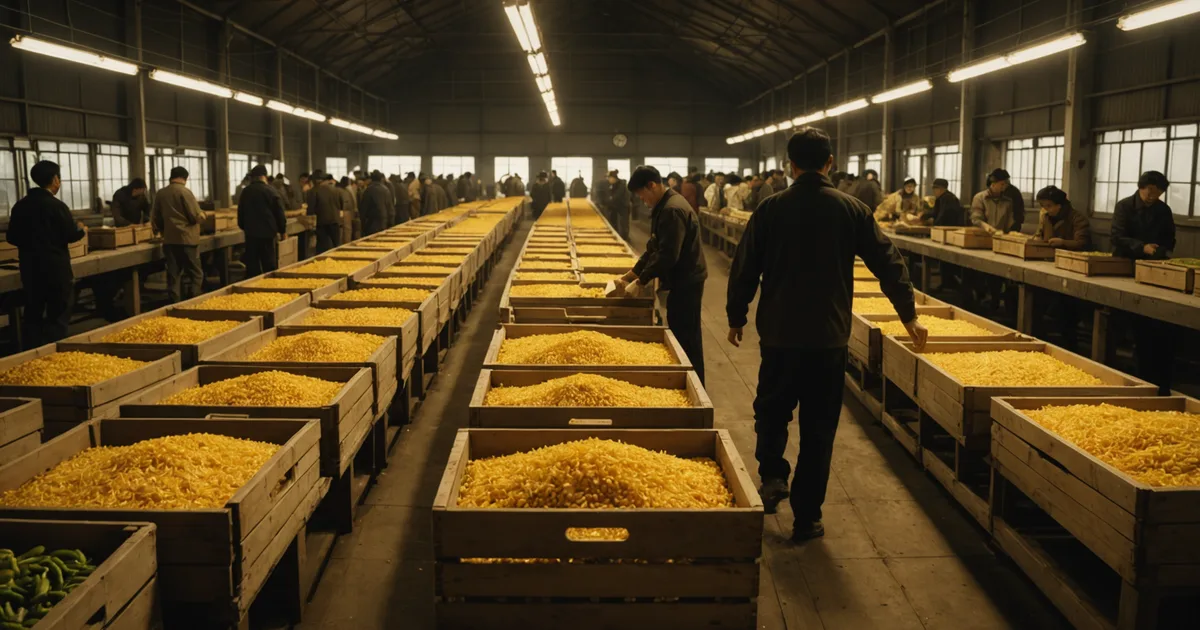
On a July afternoon, a packing facility receives 180 peach crates from three orchards. The supervisor has roughly six seconds to assess each crate on the intake line. Some traveled in refrigerated transport, while others arrived in an ambient-temperature farm vehicle. Some were picked at the proper maturity window; others stayed on the trees for two more days because rain delayed the harvest crew. Most look alike externally. A crate likely to hold six days can look much like one that will fail grading in 48 hours.
This is the information gap that routing addresses. It does not replace the supervisor. Instead, it ranks biological risk across the incoming batch before the line begins, allowing treatment choices to rely on data rather than visual judgment alone.
How Human Triage Really Works
Manual triage does the job it was built for: finding produce that has already declined. With good speed and accuracy, an experienced line worker can spot bruises, surface mold, skin damage, and obvious over-ripeness. These findings are mainly reactive, identifying deterioration that can already be seen.
Visual checks cannot reveal deterioration that has not surfaced. Produce appearing acceptable but only 12 to 24 hours from visible decline may be indistinguishable from produce with two more days of margin. A peach without external signs of advanced ripening may have elevated internal ethylene after pre-harvest heat exposure, then ripen quickly in transit and reach the retailer at a grade that prompts complaints or rejection. The progression was hidden at packing. This was not poor worker performance, but a lack of usable information.
In internal benchmark work at our pilot facilities, manual teams found about 70 to 80 percent of crates that later produced retailer quality complaints within three days. The 20 to 30 percent missed were not visibly defective crates overlooked by workers. Their problems had not yet appeared externally. They looked sound at intake, while the biological clock inside them remained unseen.
What Sensors Track
Commercial packing lines increasingly use sensor systems that extend beyond camera-based color checks. Depending on the facility's existing equipment, the Ecogear routing model generally receives some combination of the inputs below.
NIR spectroscopy measures internal sugar content, or Brix, without damaging the produce and can also measure dry matter percentage for some crops. In pome and stone fruit, intake Brix provides a useful proxy for maturity: at equivalent handling, higher Brix usually means more advanced ripening and less remaining shelf life. It is imperfect, but it strengthens triage.
Firmness readings, taken by physical probing of samples or calibrated pressure sensors built into the line, directly indicate cell wall integrity. Ripening activates pectinase and cellulase, which break down that structure and reduce firmness. A batch below the acceptable firmness threshold will become soft or bruise-sensitive sooner at retail than one within range, even when their surfaces look the same.
Camera systems produce a color index that can indicate ripening for crops whose surface color tracks that stage reliably. In peaches and nectarines, the ground color shift from green-yellow toward orange-red closely follows ripening. In apples, color is a weaker ripening signal, though uneven color across a batch can reveal field-level variation in maturity at harvest.
When transport sensors are available, temperature logs let the model account for accumulated heat exposure. A batch spending three hours above 28 degrees Celsius in an unrefrigerated farm vehicle has a different biological risk from one kept at a steady 8-degree refrigeration temperature, even if both look alike on arrival. The surface does not show that history, but the log does, and the assessment changes accordingly.
How the Routing Model Works
The model receives these readings for each crate or batch and assigns every incoming unit a treatment-priority score. That score estimates remaining shelf life under standard handling and transit. Units with less predicted shelf life receive higher priority and are marked for treatment ahead of others arriving in the same intake window.
This is not a fixed lookup table. It is trained on historical links between intake sensor readings and documented shelf-life results at later monitoring and delivery points. For each crop, the model learns how combinations of Brix, firmness, color index, and temperature history signal rapid post-harvest decline. With time, it also learns the facility's particular growing conditions and sourcing patterns.
During operation, the routing dashboard shows the line supervisor an urgency-ranked queue of incoming crates. The highest-priority units go to coating first. The lowest-priority units may receive standard handling or wait if coating capacity is constrained. On peak days, when throughput is high and the treatment window is short, the queue directs coating toward batches whose biological signals show the greatest need.
How Routing Alters Operations
The largest operational shift is separating treatment choices from the pressure of a moving line. Manual triage takes place in real time, with seconds available per crate and throughput demands in the background. A supervisor handling 40 crates at once, while watching the line, assigning staff, and managing logistics, cannot fully deliberate over each decision. The result is rapid estimation under pressure.
Routing evaluates priority at intake, before the line starts. When the first crate enters processing, the treatment order is already set. The line follows that sequence, based on recorded data rather than hurried visual estimates made in real time.
Routing also lessens the effect of individual supervisor experience. Someone who has handled stone fruit for years knows the normal appearance and can make sensible instinctive judgments. A newer supervisor, or someone working with an unfamiliar crop, faces a wider error range. The system supplies a consistent data-based baseline, narrowing variation between operators with different experience levels. It does not remove field knowledge. It establishes a floor against the poorest decisions when experience is limited or conditions are unusual.
How the Feedback Loop Changes
A frequently overlooked benefit of sensor routing is the retrospective record it creates after a quality problem is reported.
With manual sorting, the after-the-fact record usually says only whether treatment occurred. It does not preserve why that choice was made. If a retailer complains about a shipment, the facility knows what happened to the batch, but not what its incoming quality readings showed. The cause cannot be traced back.
Sensor routing records each batch's profile, connects it to the treatment choice, and eventually links it to downstream quality results. When a complaint arrives, the facility can review that batch's intake data and determine which reading first signaled the issue. Across multiple seasons, this builds a continually improving dataset that refines accuracy for the crops, growing areas, and seasonal patterns supplying that facility.
From our experience, shelf-life prediction improves substantially during a new facility's first full operating season. A model trained on industry-wide data performs at one level, while one calibrated to the facility's crop sources, handling practices, and downstream logistics performs better. Calibration requires accumulated operating data, so the first season serves as both deployment and data-gathering work.
What Routing Cannot Do
Routing is for triage and priority setting. It allocates treatment capacity. It cannot improve produce that arrives already in poor condition.
When peaches reach the packing house heat-stressed beyond a certain point, sending them first for coating may add one or two retail shelf-life days compared with untreated peaches under the same conditions. It cannot undo the heat injury. Treatment's upper limit is set by incoming quality. Routing helps apply that available benefit to the batches that need it, but it does not raise the limit for already damaged produce.
The model is also only as reliable as its data. Poor sensor calibration, missing temperature records, and inconsistent intake measurements weaken its predictions. A facility that neglects sensor upkeep will receive less value from routing than one that maintains calibration and records data consistently.
Routing cannot correct structural supply-chain failures. If field-to-packing-house transport repeatedly creates temperature exceedances, the answer is to correct transport, not to keep routing around the issue at the packing house. The model may correctly label those batches high-priority every day, but when the whole intake stream is high-risk, ranking adds little compared with fixing the upstream cause. Its batch-level records still provide the clearest diagnostic view of where problems begin in the chain, making them useful for root-cause work even when the source lies outside the packing house.
See Ecogear on your packing line
Sample kits ship within 14 days of approval. No commercial commitment required.
Request a Sample Kit