
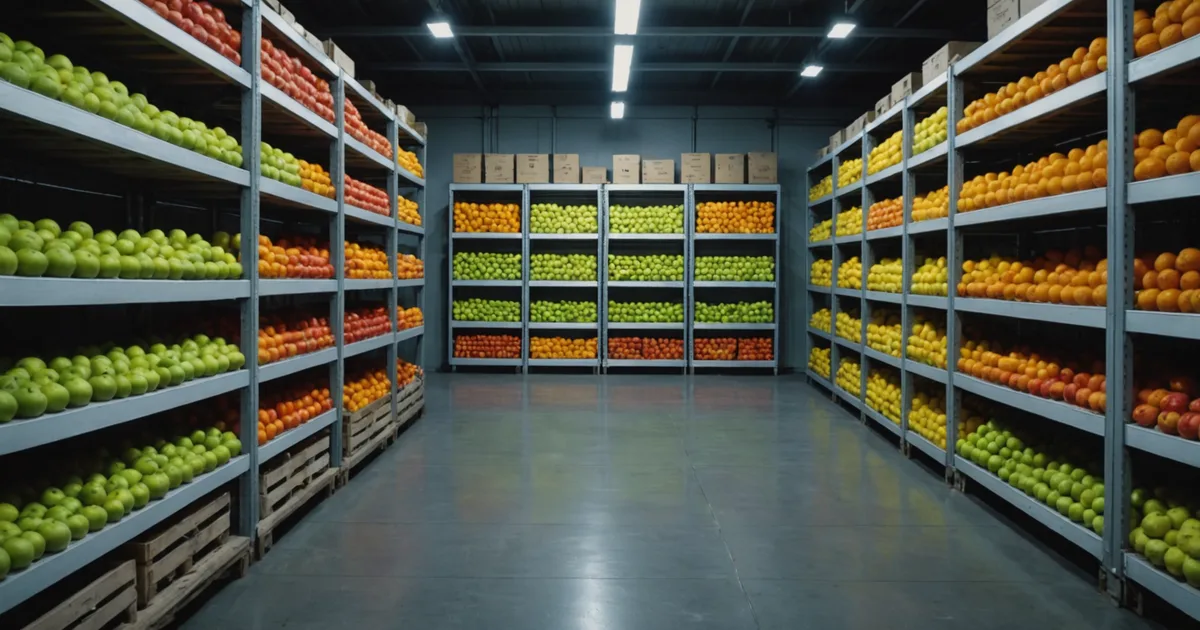
For Jeju mandarins traveling 24 to 36 hours to mainland Korea, cold chain controls the refrigerated leg well, but its hard limit is every ambient gap around that leg. Loading, unloading, and staging between cold storage and the outbound dock often take several hours at ambient temperature. Refrigeration works as intended during transit. It does not cover those gaps. A coating applied at the packing house protects the fruit through them and continues on the retail shelf, after cold chain protection has ended.
Treating cold chain and coating as opposing choices gives the wrong picture. Each uses a different mechanism and addresses a different part of spoilage. Cold chain depends on temperature control, while coating protection remains on the fruit after application and continues under ambient conditions. That distinction helps determine when one intervention is warranted and when combining both is worthwhile.
Cold Chain's Strengths
Cold chain slows the biological activity behind produce deterioration. In most fruits and vegetables, respiration responds to temperature: lowering storage temperature by 10 degrees Celsius cuts the respiration rate by approximately half. Cold conditions also slow ethylene production and sensitivity, delaying the ripening cascade in climacteric fruit such as apples, pears, bananas, and stone fruit.
When produce travels continuously from packing house through distribution center to retail under refrigeration, cold chain performs as intended. Apples stored at 0 to 4 degrees Celsius in controlled-atmosphere conditions can retain commercial quality for months. Citrus held at 6 to 8 degrees Celsius preserves rind integrity and flavor over weeks of transit. The investment makes sense when volume fills dedicated refrigerated assets and the full route remains reliably temperature-controlled.
Cold chain investment is clearly justified for high-volume operations with dependable outbound logistics, lengthy export routes, and produce valuable enough to absorb infrastructure costs. In those settings, it is the strongest single post-harvest management tool available.
The Limits of Cold Chain Alone
Cold chain fails at three predictable points, each an interval when produce remains biologically active at elevated temperature.
The first point is the interval from harvest to cooling. Field-harvested produce stays at ambient temperature until it reaches controlled conditions, making this especially important for stone fruit picked at summer peak. A peach respiring at 28 degrees Celsius deteriorates at roughly twice the rate of one at 18 degrees. Even a 2 to 3 hour summer delay from harvest to dock measurably reduces later shelf life, despite perfect cold-chain handling afterward.
The second point is the retail shelf. Most grocery stores in Korea and Southeast Asia do not maintain cold chain at retail. Produce arriving at a distribution center at 4 degrees Celsius is placed on ambient shelves at 18 to 22 degrees and stays there until purchase. For produce with a total shelf life of 7 to 10 days, spending 2 to 4 days at ambient temperature consumes a substantial part of that period. Purchase-point appearance is decided here, beyond cold chain's reach.
The third point is infrastructure access. Mid-scale operations and smaller packing facilities may not have refrigerated transport and storage available at their production volumes. Rental refrigeration adds a fixed per-crate charge that wholesale crop prices may not recover. For thin-margin produce moving through domestic channels, end-to-end cold chain may not justify its cost.
What Coating Contributes
Applied at the packing house, a food-safe coating forms a semi-permeable layer across the produce surface. It reduces transpiration, or moisture loss through the peel or skin, limits inward oxygen diffusion, and changes the CO2 and O2 exchange balance around the fruit. The result is slower respiration and ripening that continues at any temperature.
That independence from cold is the central difference. At 20 degrees Celsius on a retail shelf, a coated mandarin still respires more slowly than an uncoated one at the same temperature. The coating operates during the harvest-to-cooling interval, transit gaps, retail dwell time, and every ambient section of the supply chain beyond cold chain's coverage.
Coating also controls moisture loss in a way cold chain does not directly address. Transpiration-related weight loss affects physical yield, since growers are often paid by weight, as well as visual grade. By reducing transpiration, coating preserves surface appearance longer and lowers the number of pieces downgraded at retail for wilting, wrinkling, or surface desiccation.
The Compatibility Question
Operations already using cold chain may reasonably ask whether coating adds value beyond refrigeration. The answer turns on where the losses occur.
When the main loss source is 3 or more days on an ambient retail shelf, coating adds meaningful value regardless of transit cold-chain performance. Cold chain brings produce to the distribution center in good condition. Coating helps it retain that condition after placement on shelves, where refrigeration has stopped.
When harvest-to-cooling delay causes the main loss, packing-house coating covers a different interval from cold chain. Its effect is additive, not redundant.
If dock rejection is the main issue, meaning produce deteriorates unexpectedly during refrigerated transit, the cause may be a cold-chain break or lower-than-assumed quality at packing. Coating can help, but the underlying cause should be investigated separately.
In our pilot work, combining cold chain with coating consistently delivered higher retailer acceptance than cold chain alone. The difference was clearest when retail dwell exceeded 48 hours and when known ambient gaps existed in transit.
When to Choose One or Both
Cold chain alone fits high-volume produce with short distribution windows, uninterrupted refrigeration from packing house to retail, and margins that support the infrastructure. Bagged salad greens, pre-packaged fresh herbs, and produce sold within 24 hours of packing generally gain too little extra shelf life from coating to cover its added application cost.
Coating alone, without meaningful refrigeration, suits ambient markets where cold-chain infrastructure is limited or cannot recover its cost. Mangoes coated at a packing house in the Mekong Delta and moved through ambient truck distribution gain substantial protection even when no cold chain is used anywhere in the route.
Using both is appropriate for stone fruit, citrus, and pome fruit moving through regional Korean channels with retail periods longer than 2 days; export produce traveling for multiple days; and operations where losses arise during both transit and retail. Adding coating to an existing cold-chain operation costs little, while its retail-stage benefit is consistent.
Infrastructure Cost Considerations
Cold chain demands investment in refrigerated storage, refrigerated transport, and the energy required to hold temperature throughout the route. These costs can be recovered at scale, but not every operation can access them, and they do not shrink linearly for small volumes.
Coating carries an operating cost per kilogram and needs no capital beyond application equipment. That equipment can fit standard dip or spray stations on existing packing lines. Cost remains predictable, scales linearly with throughput, and requires no dedicated infrastructure.
The choice is not a simple comparison of coating cost per kilogram against cold-chain cost per kilogram. Compare cold chain's complete capital and operating cost, amortized over actual volume, with coating's operating cost for each treated kilogram. At mid-scale volumes, coating is often the more accessible starting point, with refrigeration added as volume increases.
Neither method fully resolves post-harvest loss alone. Cold chain reaches its limit at the retail shelf, while coating cannot replace the temperature control needed for extended storage. Choose by locating the actual loss points in the supply chain and matching the intervention to the stage where deterioration occurs.
See Ecogear on your packing line.
Sample kits ship within 14 days of approval. No commercial commitment required.
Request a Sample Kit